
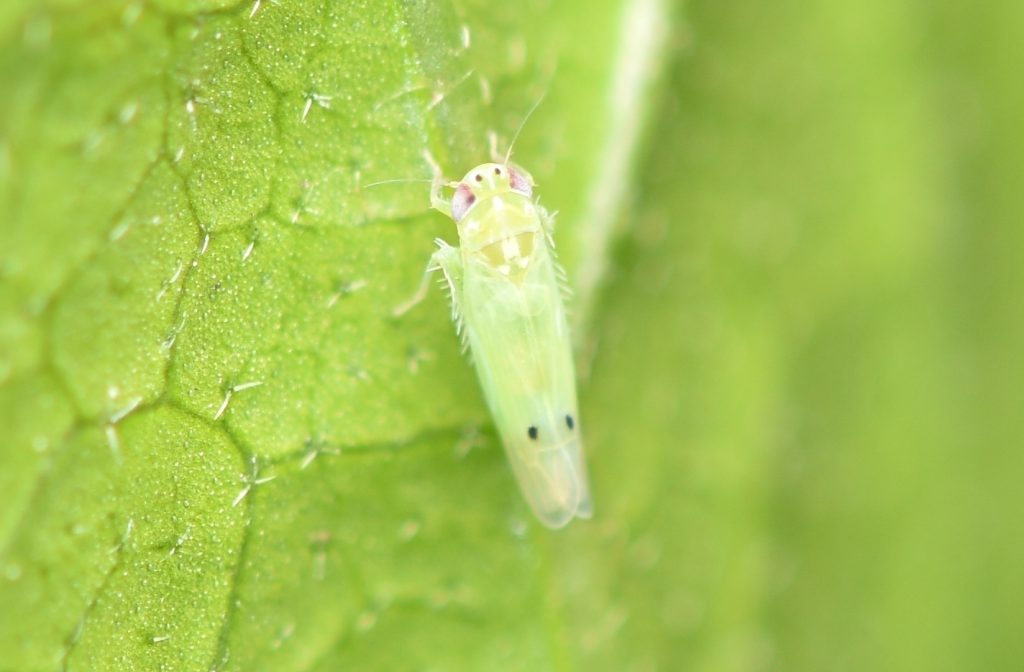
The two-spot cotton leafhopper (TSCL), Amrasca biguttula, also known as the cotton jassid, emerged in the southeastern United States with unusual speed and complexity. As Entomology Today reported, growers and extension personnel throughout the southeast began encountering unexplained leaf curling, yellowing, and decline in susceptible crops and ornamentals. Clemson News similarly described how what began as an unusual problem for one grower “quickly escalated into a coordinated, multistate scientific effort,” as diagnosticians and researchers across the region recognized the same symptoms.
By early 2026, TSCL had been confirmed across a broad geographic range, including Alabama, Florida, Georgia, Louisiana, Mississippi, North Carolina, South Carolina, and Texas. States outside this distribution were also at risk due to the movement of hibiscus and other susceptible ornamentals. Early detection was especially difficult because the insect inserts its eggs deep within lead veins and midribs, allowing apparently healthy plants to be shipped while unknowingly spreading the pest across state lines.
As detections increased, it became clear that TSCL was not confined to ornamentals. Clemson News documented impacts in cotton, eggplant, okra, and other vegetables, while Entomology Today emphasized the pest’s ability to move freely among ornamental, vegetable, and cotton systems. This broad host range created a multisector challenge, with ornamental hosts such as hibiscus and roselle acting as reservoirs that sustained populations between cropping cycles and enabled movement into nearby agricultural fields. Combined with the pest’s mobility and ability to cause hopperburn and yield loss, these factors underscored the need for a unified, science-based response. Because TSCL crosses commodity boundaries and moves through both trade and natural dispersal, no single state or crop sector could address the problem alone.

Diagnostic labs, extension agents, and researchers across the region were encountering many of the same questions simultaneously. Four major areas of inquiry included: biology and phenology, host associations and movement, diagnostics and early detection, and regulatory and trade concerns. These shared questions underscored the need for coordinated monitoring, shared diagnostics, unified communication, and regionally aligned management strategies.
How Regional Response Was Built

As TSCL spread across the Southeast, the need for structured coordination became urgent. To support this effort, Zee Ahmed organized the multistate TSCL Working Group through a secured Southern IPM Center Working Group grant (Project S26-075). This support enabled the creation of the regional Working Group, the development of shared tools and templates, and the launch of Stop2SCL.org, a centralized practitioner-focused website built in partnership with the Bugwood Center for Invasive Species and Ecosystem Health.
This infrastructure provided the foundation needed to bring researchers, extension personnel, regulators, and industry partners together to align priorities and establish a shared roadmap for managing TSCL across the Southeast.
What the First Working Group Meeting Accomplished
The April 20th, 2026 Working Group meeting marked a major step forward in regional alignment. The session was led by Dr. Mahamed “Zee” Ahmed (Clemson University) as Lead Moderator, supported by Dr. Isaac Esquivel (UF-IFAS), Dr. Tyler Raszick (APHIS-PPQ), Dr. Justin George (USDA-ARS), and Dr. Amy Louise Roda (UF-IFAS) as Chat Monitor. The meeting was sponsored by Cotton Incorporated.
The meeting was designed not only to share updates, but to identify regional priorities. Commodity specialists provided early-season updates on cotton, vegetables, and ornamentals, followed by federal updates from APHIS-PPQ and ARS. The discussion was further guided with an international perspective from India’s Central Institute for Cotton Research, which offered insight into long-term management challenges within the pest’s native range. Participants then worked through commodity-specific and cross-commodity discussions to identify immediate and long-term needs. The group reached consensus on a regional priority list that will help guide the development of a Pest Management Strategic Plan (PMSP). The priorities include early detection, diagnostics, overwintering biology, virus risk assessment, resistance management, unified communication tools, shared sampling protocols, and reporting templates.
By the end of the session, the Working Group produced a clear, regionally aligned set of priorities that will guide coordinated research, extension, and regulatory actions across the Southeast. This level of participation made it the largest and most diverse TSCL meeting held to date.
Who Participated
The Working Group brought together a broad and balanced representation of the region’s scientific, regulatory, and industry expertise. In total, the meeting successfully assembled 94 participants representing 17 states and universities, two federal agencies, multiple state departments of agriculture, extension and diagnostic representatives, industry partners, and international collaborators with long-term experience managing TSCL.
This breadth of participation reflects the pest’s cross-commodity nature and the region’s commitment to a unified, science-based response.
What Happens Next
This fall at the Entomological Society of America’s annual meeting the work will continue. The TSCL Working Group will hold a formal session on November 10th, 2026. This session will feature a regional priority list, early results from cotton vial assays, updates from the Animal and Plant Health Inspection Service (APHIS) and Agricultural Research Service (ARS), as well as coordinated guidance for 2027.
The Working Group is also preparing a publishable article summarizing the regional priority list developed during the April 20th meeting. This document will serve as a shared roadmap for researchers, extension personnel, regulators, and industry partners. In the next phase, the Working group’s priorities will be translated into applied tools that growers, regulators, and industry partners can use immediately.
The Bigger Picture: A Model for Future Invasive Species
TSCL represents only one instance of the growing pressure invasive species are placing on southeastern agriculture. Clemson News and Entomology Today emphasized that “invasive species are increasing, and so is the pressure on us to respond faster and smarter.” Built around early detection, coordinated diagnostics, unified communication, and regionally aligned management, the rapid-response framework developed for TSCL offers a practical model for future invasive species that cross crop boundaries and move through trade networks. The structure, participation, and outcomes of the Working group demonstrate how the Southeast can respond collectively and effectively to emerging pest threats. While the fight against TSCL continues, the system built to address it may ultimately prove even more valuable as a template for managing the next invasive species already on its way.
More on the working group
For more information about the working group and resources about TSCL, visit their webpage.