
Friends of IPM Awards
The mission of the Southern IPM Center is to champion the development and adoption of integrated pest management (IPM), the science of managing pests while protecting people, the environment and economy. Each Regional Center engages broadly with stakeholders to identify and address regional pest priorities in agriculture, communities and natural areas.
Since 2003, the Southern IPM Center (SIPMC) has worked with USDA, Land Grant universities, Extension, and many other partners in promoting and facilitating the development and implementation of IPM in many settings across the region.
Many of these partners have contributed to the region’s well-being for years or even decades.
Hall of Fame
The Southern IPM Hall of Fame award recognizes individuals who have contributed to any important aspect of Southern IPM over many years with documented history of career achievements in IPM.
Along with authorship of educational materials, research papers, manuals, books, and presentations of IPM material, Hall of Fame award candidates have greatly impacted IPM in the Southern region over the lifetime of their career.
At the time Dr. David Buntin received this honor, it was known as the Southern IPM Lifetime Achievement Award. The award has since been renamed the Southern IPM Hall of Fame Award and continues to recognize individuals whose careers have had a lasting impact on integrated pest management.

David Buntin, University of Georgia
Written by Abbey Stewart
Dr. G. David Buntin is an Entomology Professor at the University of Georgia, Griffin campus in Griffin, Georgia. He received his B.S. degrees in Entomology and Applied Ecology from the University of Delaware. He later received his M.S. and Ph.D. in Entomology from Iowa State University.
Since 1984, Dr. Buntin has been a faculty member in the Department of Entomology at the University of Georgia (UGA), where he researches applied insect biology and the development of arthropod pest management programs for grain and forage crops.
Over the years, Dr. Buntin has conducted extensive work on the Hessian fly and other insect pests of cereal grains. His work has subsequently been used to develop an integrated crop management program for winter wheat in Georgia, which has minimized crop losses from insect pests.
Through his research program, Dr. Buntin works closely with a team of scientists at UGA to develop high-yield, adapted cereal grain cultivars with strong pest resistance. As a result of their efforts, 16 winter wheat cultivars have been released, all with high levels of Hessian fly resistance.
Drawing on 26 years of data, Dr. Buntin collaborated with colleagues at Auburn University to investigate the effects of Southern Oscillation climate patterns on Hessian fly populations, wheat yield, and the performance of resistant wheat varieties. The study demonstrated that Hessian fly infestations and resulting yield losses are more severe during La Niña years than during El Niño years, highlighting the increased importance of host plant resistance under La Niña conditions.
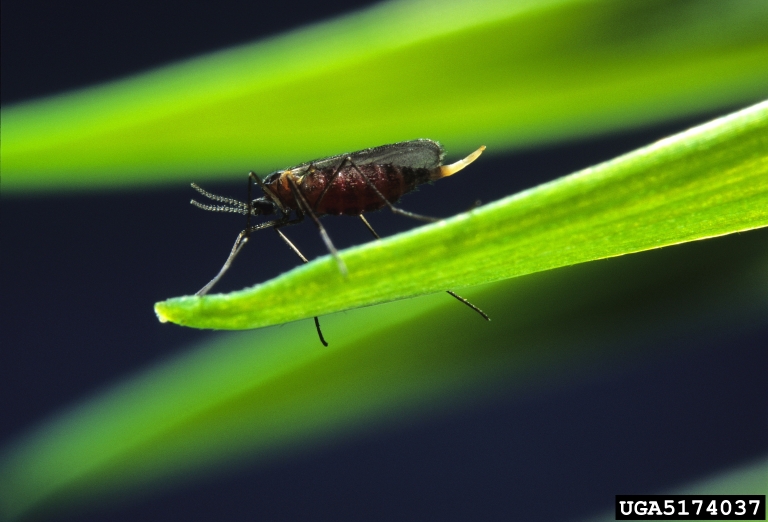
Adult Hessian fly (Mayetiola destructor). Photo credit: Scott Bauer, USDA Agricultural Research Service, Bugwood.org
In addition, Dr. Buntin worked to develop and implement effective IPM plans for insect pests of field corn, grain sorghum, and pearl millet. His work on corn has focused on evaluating new systemic insecticide seed treatments and on using transgenic corn containing Bt toxins to control lepidopteran pests. Dr. Buntin and his graduate students have identified appropriate situations in which seed treatments are effective and in which Bt corn is a cost-effective option for preventing losses caused by lepidopteran pests. Dr. Buntin’s work has also informed modeling efforts conducted by the corn seed industry and Bt trait registrants, contributing to the development of resistance management plans for Bt corn products used throughout the southern United States.
Dr. Buntin also has an Extension appointment, where his primary programming responsibilities are for insect pests of grain crops. His extension efforts deliver timely research results on the management of grain, forage, and alternative crops to county agents, agricultural industry personnel, crop consultants, and growers through traditional training sessions and annual crop production guides available in print and online.
Beyond his research and Extension responsibilities, Dr. Buntin also teaches IPM concepts to undergraduate students through the College of Agriculture and Environmental Sciences degree programs at the UGA-Griffin campus. He teaches sections of General Entomology, in which he shares fascinating information about insect morphology, diversity, and ecology, as well as foundational IPM concepts.
Since 1978, Dr. Buntin has been an active member of the Entomological Society of America (ESA). He has served on the editorial board of the Journal of Economic Entomology, chaired the editorial board, and been a member of the applied Entomology program committee, and has organized numerous conferences and sessions at national ESA meetings.
Dr. Buntin was also the associate editor for the Journal of Entomological Sciences and the subject editor for Pest Management for Agronomy Journal. Dr. Buntin served on several EPA-STAR Graduate Fellowship panels, regional IPM panels, the National Canola Research Program, and several state and local grant programs.
Several professional societies have recognized his outstanding contributions in the field of Entomology. In 2006, Dr. Buntin received the ESA Recognition Award in Entomology and was honored as a Fellow of the Georgia Entomological Society in 2011.
Dr. G. David Buntin has made exceptional contributions to integrated pest management through more than 32 years of research, extension, and professional service. The impact of his work has extended beyond the southern United States, benefiting producers, researchers, and pest management programs across the nation and around the world.