
Friends of IPM Award
The mission of the Southern IPM Center is to champion the development and adoption of integrated pest management (IPM), the science of managing pests while protecting people, the environment and economy. Each Regional Center engages broadly with stakeholders to identify and address regional pest priorities in agriculture, communities and natural areas.
Since 2003, the Southern IPM Center (SIPMC) has worked with USDA, Land Grant universities, Extension, and many other partners in promoting and facilitating the development and implementation of IPM in many settings across the region.
Many of these partners have contributed to the region’s well-being for years or even decades.
Graduate Student Award
The Friends of IPM Award program typically recognizes two graduate students per award year: one in a Master’s program and one in a Ph.D. program in the Southern region of the United States.
Recipients of this award have demonstrated strong potential of providing leadership in IPM as evidenced through fieldwork, data collection, experimental design, teaching, outreach, or other support for research, Extension, and/or education IPM projects. They must also be enrolled at a college or university located within the Southern Region of the United States and working in IPM related disciplines such as entomology, plant pathology, nematology, and weed science.
Tennyson Bilinkhinyu Nkhoma, University of Florida, Department of Entomology and Nematology
Written by Abbey Stewart
Thesis: Improving Thrips Management and Crop Resilience in Florida Lettuce
Areas of Specialization:
- Frankliniella occidentalis (Western flower thrips) management
Tennyson Bilinkhinyu Nkhoma was a master’s student at the University of Florida studying the management of thrips vectors, Frankliniella occidentalis (Western flower thrips), of Impatiens necrotic spot virus in lettuce under the supervision of Dr. De-fen Mou.
Frankliniella occidentalis
Tennyson’s innovative research sought to safeguard Florida’s lettuce industry from the emerging threat of Impatiens necrotic spot virus (INSV), a thrips-transmitted virus that causes devastating crop losses. By systematically studying thrips population dynamics, species composition, and INSV incidence in Florida lettuce fields, Tennyson endeavored to establish a critical baseline understanding of the current pest and disease status. Specifically, he assessed the presence of western flower thrips, the primary INSV vector, in Florida lettuce and evaluated the potential risk of virus outbreak.
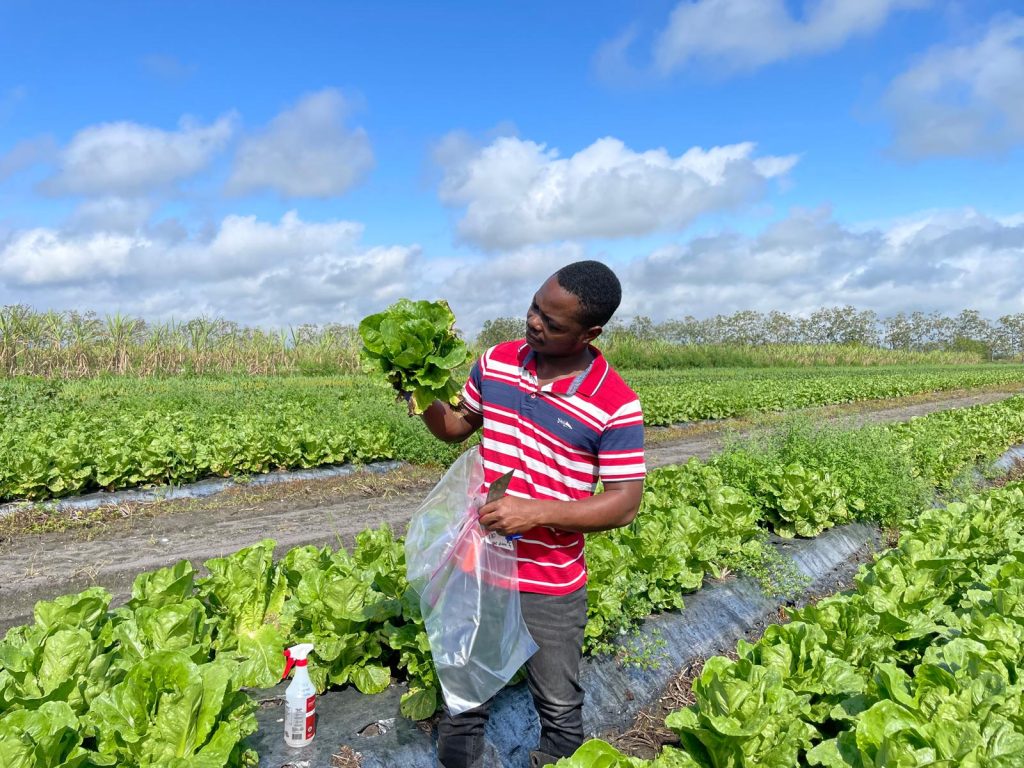
Tennyson in a lettuce field.
Every week, Tennyson visited lettuce farms during lettuce growing seasons to collect insect and lettuce samples. He also screened 35 lettuce cultivars for resistance to western flower thrips and identified two thrips-resistant cultivars, offering valuable genetic resources for breeding programs to develop lettuce varieties for IPM. Through his impactful research project, Tennyson provided both immediate insights and long-term solutions to protect Florida’s lettuce production from future pest and disease outbreaks.
Publications
During his visits to lettuce farms, Tennyson fostered meaningful relationships with lettuce growers and crop consultants, discussing pest issues and providing updates on his research findings. These interactions greatly informed “Common Pests of Lettuce Crops in Florida,” a UF/IFAS EDIS publication for which Tennyson served as first author. A valuable resource for lettuce growers, Tennyson’s publication introduces common insect pests of lettuce, including serpentine leafminers and thrips, and the damage they cause, helping growers better understand these pests.
In addition, Tennyson has also authored one peer-reviewed publication titled “A Synopsis of Two Decades of Related Research at the Forensic Anthropology Research Facility (FARF), Texas State University (TXST), San Marcos, Texas, USA. Although not directly related to his thesis, this collaborative work highlights Tennyson’s ability to contribute meaningfully to interdisciplinary research and broader scientific engagement.
Presentations
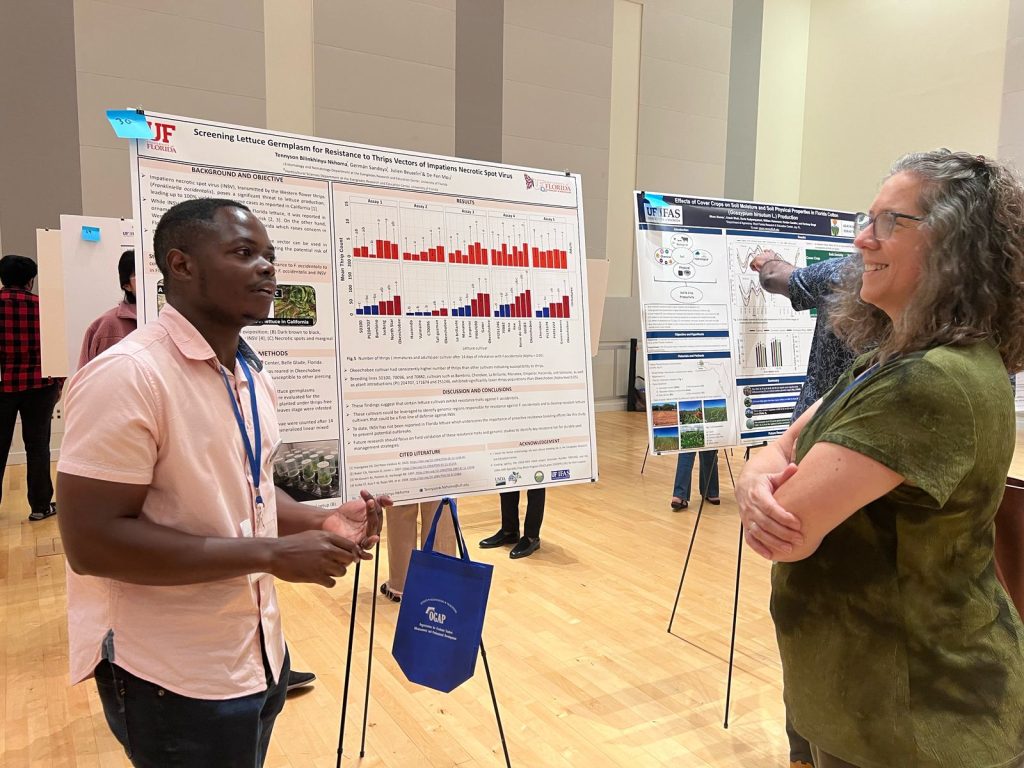
Tennyson has presented his research through both posters and oral presentations at local, regional, and national conferences. He presented his research findings during the Fall and Spring Lettuce Advisory Meeting at the UF/IFAS Everglades Research and Education Center. Tennyson also shared his lettuce screening results for thrips resistance at the 2026 Fall Lettuce Advisory Meeting on October 2, 2025.
Leadership and Service
While pursuing his master’s degree at the University of Florida, Tennyson demonstrated strong leadership and service in support of IPM through roles in academic organizations and community outreach. As Secretary of the UF/IFAS Everglades Research and Education Center (EREC) Student Association, he organized student activities and helped coordinate a major research symposium.
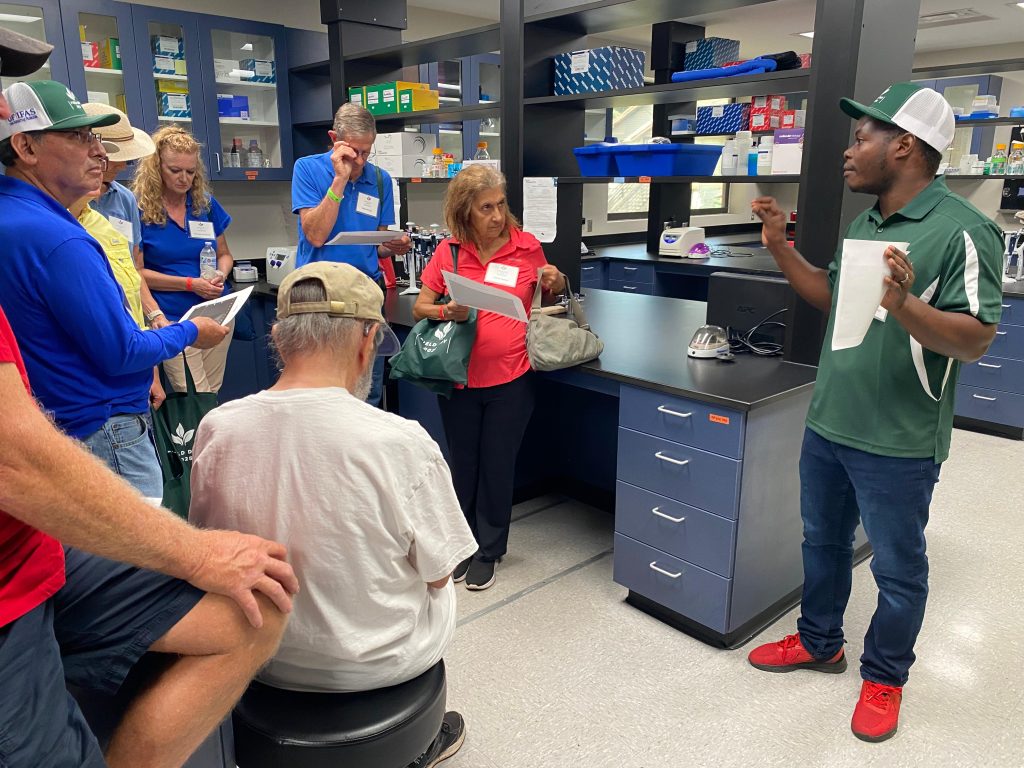
Tennyson also led lab tours and educated the public, especially elementary students, about insect pests and biological control through programs, school visits, and community events, reflecting a commitment to both scientific engagement and public education.
Lorem ipsum dolor sit amet, consectetur adipiscing elit. Ut elit tellus, luctus nec ullamcorper mattis, pulvinar dapibus leo.
Tennyson speaking with an audience in the lab.
Special Thanks and Future Plans
Tennyson would like to thank his advisor, Dr. De-fen Mou, for his guidance during the research process. Tennyson would also like to thank his wife, Alaida, for her endless support throughout his master’s studies.
Tennyson recently began his Ph.D. studies at the University of Nebraska-Lincoln, where he will be continuing his work in integrated pest management. His project will focus on understanding the ecology of alfalfa weevils in the field and on conducting pesticide efficacy studies to improve management recommendations.