
Friends of IPM Awards
The mission of the Southern IPM Center is to champion the development and adoption of integrated pest management (IPM), the science of managing pests while protecting people, the environment and economy. Each Regional Center engages broadly with stakeholders to identify and address regional pest priorities in agriculture, communities and natural areas.
Since 2003, the Southern IPM Center (SIPMC) has worked with USDA, Land Grant universities, Extension, and many other partners in promoting and facilitating the development and implementation of IPM in many settings across the region.
Many of these partners have contributed to the region’s well-being for years or even decades.
The IPM Communicator Award, 2026
The IPM Communicator award is presented to a professional that effectively communicates about IPM in either a formal or informal setting and actively engages in communication about IPM using either in-person and/or online channels.
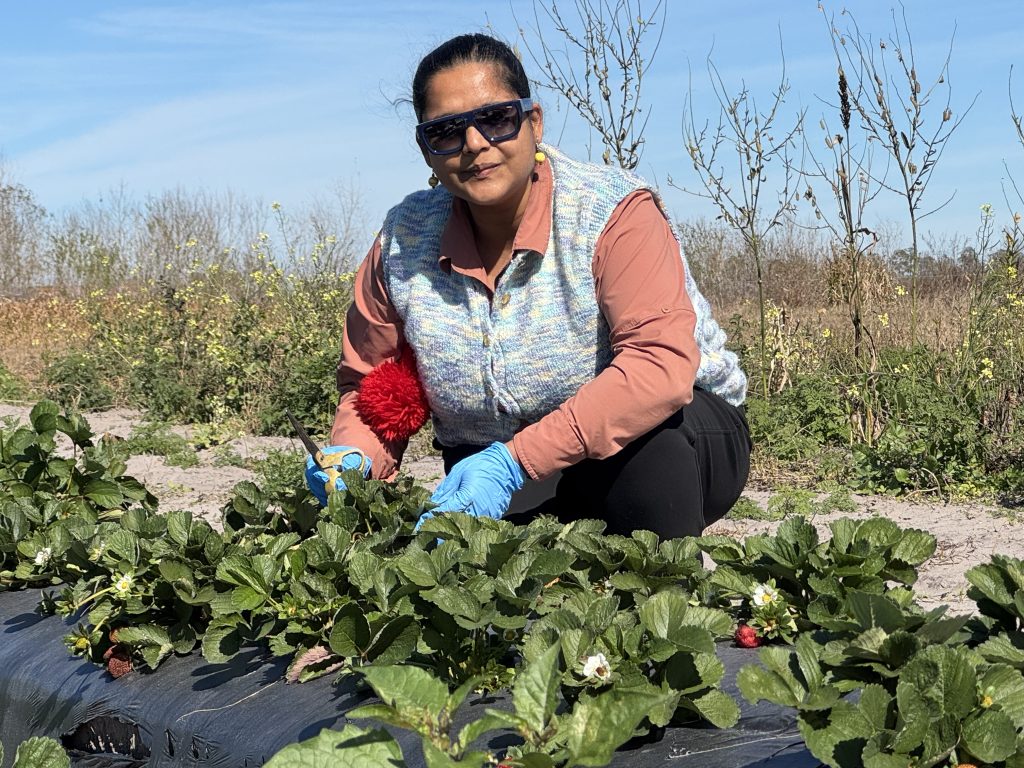
Dr. Sriyanka Lahiri, University of Florida, Entomology & Nematology Department at the Gulf Coast Research and Education Center
Written by Abbey Stewart
Dr. Sriyanka Lahiri is an Assistant Professor of Small Fruit Crop Entomology at the University of Florida. Since the start of her appointment in 2019, Dr. Lahiri’s research and Extension programs have had a profound impact on strawberry and blackberry growers in Florida and beyond. She effectively communicates findings driven by stakeholder needs, which has led to substantial behavior change in growers, with many adopting IPM practices that reduce unnecessary pesticide applications and improve long-term pest management sustainability.
Dr. Lahiri has helped shift the small fruit industry’s approach to insect pest management by consistently promoting IPM strategies that integrate cultural, biological, physical, and biorational controls. Her work on invasive chili thrips management has been especially influential, with at least 30% of the Florida strawberry industry now incorporating tools such as augmentative biological control, reflective mulch, and biopesticides into their pest management programs. Through accurate pest identification and targeted IPM recommendations, Dr. Lahiri estimates that her communication efforts save Florida strawberry growers between $700,000 and $1.68 million annually.
An important feature of Dr. Lahiri’s communication program is hands-on education through live pest demonstrations at field days and workshops. Alongside her graduate students, she regularly displays live specimens of thrips, mites, and beneficial insects to help growers better understand pest identification and biological control programs. Since 2019, she has delivered 38 field-day talks for more than 1,300 growers, provided dozens of field consultations, and trained hundreds of Extension personnel through in-service programs.
Dr. Lahiri also communicates IPM information through a wide range of media platforms. She has written for nine agricultural industry newsletters and participated in 19 media interviews to educate both growers and the public about pest management issues affecting small fruit crops. During periods of widespread misinformation on social media concerning insects in strawberries, Dr. Lahiri worked directly with national and local media outlets to reassure consumers and support growers by providing clear, science-based information.
In addition to Extension publications and presentations, Dr. Lahiri manages the strawberry insect pest section of the “MyIPM” cellphone application, where she regularly updates stakeholders on new pest management tools and recommendations. She also uses webinars and YouTube videos to communicate IPM strategies to growers across the southeastern United States and internationally, including audiences in Egypt, Spain, West Africa, Nepal, and India. Her work has helped expand awareness of and adoption of innovative pest management tools, such as ultraviolet light for spider mite suppression, influencing growers and agricultural technology companies as far away as California.
Through Extension publications, field demonstrations, digital resources, media outreach, and direct stakeholder engagement, Dr. Lahiri has become a trusted source of IPM information for the small fruit industry. Her ability to translate complex research into practical recommendations has transformed how many growers approach pest management and strengthened adoption of sustainable IPM practices throughout the southern region and beyond.