
Friends of IPM Awards
The mission of the Southern IPM Center is to champion the development and adoption of integrated pest management (IPM), the science of managing pests while protecting people, the environment and economy. Each Regional Center engages broadly with stakeholders to identify and address regional pest priorities in agriculture, communities and natural areas.
Since 2003, the Southern IPM Center (SIPMC) has worked with USDA, Land Grant universities, Extension, and many other partners in promoting and facilitating the development and implementation of IPM in many settings across the region.
Many of these partners have contributed to the region’s well-being for years or even decades.
The IPM Hall of Fame Award, 2026
The Southern IPM Hall of Fame award recognizes individuals who have contributed to any important aspect of Southern IPM over many years with a documented history of career achievements in IPM.
Along with authorship of educational materials, research papers, manuals, books, and presentations of IPM material, Hall of Fame award candidates have greatly impacted IPM in the Southern region over the lifetime of their career.
This year, three exceptional Entomologists were inducted into the Southern IPM Center’s IPM Hall of Fame.
Lawrence C. “Fudd” Graham, Auburn University
Written by Abbey Stewart
Before his retirement in 2022, Dr. Lawrence C. “Fudd” Graham was a Research Fellow and Extension Specialist in the Department of Entomology and Plant Pathology at Auburn University. He specialized in red imported fire ant (Solenopsis invicta), phorid flies (Pseudacteon curvatus), and school integrated pest management.
Dr. Graham was born and raised in Tuscaloosa, Alabama, on his family’s farm. He was the first in his family to attend college and obtain a Ph.D.
Dr. Graham worked on integrated approaches that combine biological control and insect growth regulators to sustainably suppress the red imported fire ant. He conducted pioneering research on phorid fly releases to establish biological control strategies for red imported fire ants in southeastern pastures, a novel form of fire ant management at the time. Dr. Graham helped develop lower-toxicity fire ant management approaches so farmers and ranchers could immediately use hay and grazing land after treatment.
One of the most impactful research contributions of his career, Dr. Graham helped secure EPA funding in 2003, in partnership with the Alabama Department of Agriculture and Industries, to implement a statewide school IPM program through a stakeholder coalition.
By collaborating with D. Marc Lame and others, Dr. Graham advanced national school IPM awareness and improved early coalition models by aligning them more closely with core IPM principles drawn from agricultural scouting. His approach emphasized inspection, accurate pest identification, non-chemical controls, education, and ongoing evaluation supported by strong communication between schools and pest management professionals.
insert some fake text here
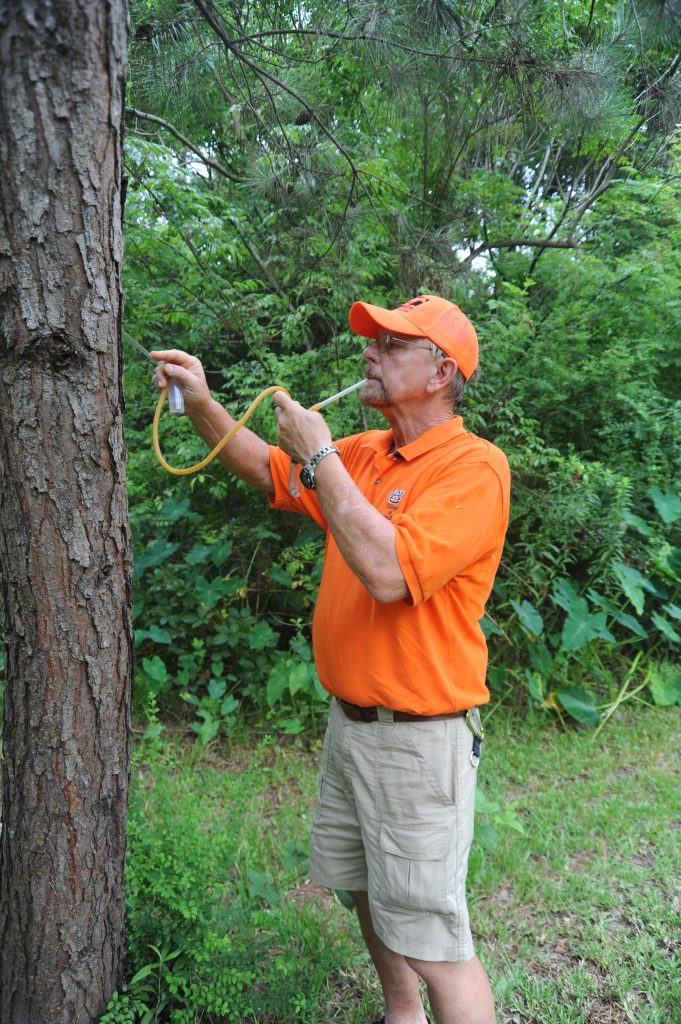
Dr. Lawrence Graham collecting crazy ants in Mobile.
Over his forty-year career, Dr. Graham has introduced behavioral changes in farmers, ranchers, athletic directors, school administrators, and structural pest control operators. His efforts have helped farmers and ranchers adopt biological control strategies and reduced-risk treatments for fire ants in pastures. Dr. Graham encouraged pesticide applicators to replace ineffective baseboard spraying techniques with gel baits and granular fire ant baits. He also worked with school administrators, custodial staff, and food service managers to implement prevention-focused IPM programs.
Dr. Graham co-authored 11 peer-reviewed research publications focused on fire ant biological control and phorid fly research. Many of his publications were in collaboration with the USDA-ARS Imported Fire Ant and Household Insects Research Unit in Gainesville, Florida. He also authored or co-authored 42 Extension publications, several of which were a national school IPM effort.
Beyond his publication record, Dr. Graham also delivered numerous presentations at local, state, and national meetings. He delivered 95 Extension programming presentations in the southern region and served as an invited speaker at 42 local and national events. In addition, Dr. Graham was one of the subject-matter experts on fire ants and gave several TV interviews about them.

Dr. Graham explaining phorid release procedures to a senator and the Commissioner of Agriculture.
Dr. Graham also placed a high priority on mentorship throughout his career as a Research Fellow and Extension Specialist. Although he mentored five graduate students at Auburn, Dr. Graham was known for mentoring beyond academia, including pest control workers, farmers and ranchers, Extension specialists, and colleagues.
Dr. Lawrence C. “Fudd” Graham transformed school and urban IPM from an abstract concept into a practical, relationship-driven system focused on prevention, education, and human health, and he is overwhelmingly deserving of this honor.