
Friends of IPM Awards
The mission of the Southern IPM Center is to champion the development and adoption of integrated pest management (IPM), the science of managing pests while protecting people, the environment and economy. Each Regional Center engages broadly with stakeholders to identify and address regional pest priorities in agriculture, communities and natural areas.
Since 2003, the Southern IPM Center (SIPMC) has worked with USDA, Land Grant universities, Extension, and many other partners in promoting and facilitating the development and implementation of IPM in many settings across the region.
Many of these partners have contributed to the region’s well-being for years or even decades.
Graduate Student Award
The Friends of IPM Award program typically recognizes two graduate students per award year: one in a Master’s program and one in a Ph.D. program in the Southern region of the United States.
Recipients of this award have demonstrated strong potential of providing leadership in IPM as evidenced through fieldwork, data collection, experimental design, teaching, outreach, or other support for research, Extension, and/or education IPM projects. They must also be enrolled at a college or university located within the Southern Region of the United States and working in IPM related disciplines such as entomology, plant pathology, nematology, and weed science.
Allan Busuulwa, University of Florida, Department of Entomology and Nematology

Written by Abbey Stewart
Dissertation: Understanding the potential of banker cropping, companion planting, and insect genetic sequencing to develop an IPM program for invasive pest, Scirtothrips dorsalis Hood.
Areas of Specialization:
- IPM of insect and mite pests
- Fruit crops: strawberry, blueberry, blackberry, and pomegranate
- Scirtothrips dorsalis Hood (Invasive chili thrips)
- Polyphagotarsonemus latus Banks (Broad mites)
- Tetranychus urticae Koch (Two-spotted spider mites)
Allan Busuulwa is a Ph.D. student at the University of Florida whose research focuses on enhancing pest management in fruit crops through the integration of biological control with conventional pest management strategies.
Ecological Theory Meets Applied Pest Management
Allan’s inventive research bridges ecological theory with applied pest management techniques to directly improve grower decision-making.
Allan’s Ph.D. research focuses on improving chili thrips management in strawberry by reducing reliance on chemical insecticides and enhancing biological control. He is also examining how insecticide resistance develops and declines over time to inform more effective pesticide rotation strategies.
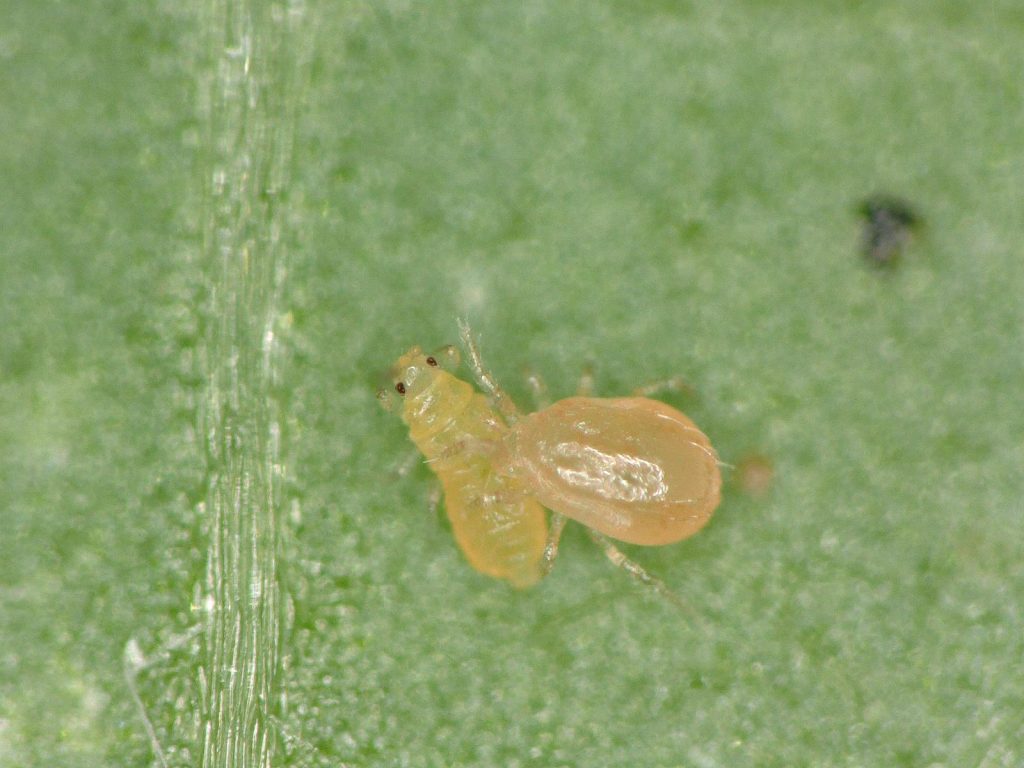
Predatory mite feeding on thrips larvae.
His research has advanced biological control of chili thrips by using predatory mites and identifying which pesticides are compatible with natural enemies. His work has already contributed to a significant decrease in insecticide use, reducing applications and cutting tens of thousands of pounds of harmful chemicals annually.
In addition, Allan has developed banker plant systems to support and sustain predator populations, reducing the need for frequent pesticide applications. These strategies have already been adopted by growers, demonstrating the real-world impact of Allan’s work.
Stakeholders and Community Engagement

Allan Busuulwa giving an Extension talk to an audience of elementary schoolers.
During his doctoral studies, Allan has placed a high priority on sharing his research with growers and the community. Each year, he presents at the UF/IFAS Strawberry Field Day and conducts on-farm workshops where he directly works with farmers. During these workshops, Allan instructs participants on how to identify predatory mites and effectively incorporate them into their strawberry production systems.
In addition, Allan also volunteers as a free entomology consultant for the Tillers and Toilers Gardening Club in Sun City, Florida, where he helps retirees identify pests and find simple management solutions for their home gardens.
Allan also works with young people and the general public. He has spoken to over 120 high school students about insect science at the Youth AgExpo. Through these efforts, Allan ensures that his research is accessible to farmers, students, and the broader community.
Publications
Allan has produced a strong body of publications that effectively translate research into practical pest management solutions for growers. He has authored three Extension articles, two of which are peer reviewed, that communicate actionable IPM strategies to both technical and public audiences. His work in Arthropod Management Tests evaluates reduced-risk insecticides for chili thrips control, providing critical data that can support new pesticide registrations for small fruit crops. Additionally, his UF/IFAS EDIS factsheet offers step-by-step guidance on implementing banker plant systems, while his public-facing article in In Field Magazine introduces these concepts in accessible terms. Together, these publications demonstrate his ability to bridge scientific research and real-world applications, addressing challenges such as chili thrips and twospotted spider mites in small-fruit systems.
Beyond his Extension articles, Allan has authored six peer-reviewed journal articles, including four as first author, in respected journals such as Applied Acarology and the Journal of Economic Entomology. Overall, his publication record reflects high productivity and a clear emphasis on applied research that directly benefits growers.
Presentations
Allan has delivered approximately 23 presentations, including scientific talks, posters, and invited outreach presentations, showcasing his research to both academic and professional audiences. He has presented at major conferences, including the International Congress of Entomology and multiple Entomological Society of America meetings. Allan has also been invited to speak to growers and professional groups, demonstrating his ability to communicate research clearly and effectively beyond academia. His work has been recognized with several awards, including first place in the Ph.D. oral competition at the Florida Entomological Society annual meeting in 2025.
Special Thanks and Future Plans
Allan would especially like to thank his advisor, Dr. Sriyanka Lahiri, for her mentorship and training over the years. Her guidance has played a significant role in shaping his scientific thinking and professional development. Allan is also grateful for his collaborators and the members of his research group who have supported and contributed to his work.
After completing his Ph.D., Allan intends to pursue a career that enables him to conduct impactful research while mentoring and training the next generation of scientists.