Friends of IPM Awards
The mission of the Southern IPM Center is to champion the development and adoption of integrated pest management (IPM), the science of managing pests while protecting people, the environment and economy. Each Regional Center engages broadly with stakeholders to identify and address regional pest priorities in agriculture, communities and natural areas.
Since 2003, the Southern IPM Center (SIPMC) has worked with USDA, Land Grant universities, Extension, and many other partners in promoting and facilitating the development and implementation of IPM in many settings across the region.
Many of these partners have contributed to the region’s well-being for years or even decades.
Graduate Student Award
The Friends of IPM Award program typically recognizes two graduate students per award year: one in a Master’s program and one in a Ph.D. program in the Southern region of the United States. This year, there are two Ph.D. awardees, instead.
Recipients of this award have demonstrated strong potential of providing leadership in IPM as evidenced through fieldwork, data collection, experimental design, teaching, outreach, or other support for research, Extension, and/or education IPM projects. They must also be enrolled at a college or university located within the Southern Region of the United States and working in IPM related disciplines such as entomology, plant pathology, nematology, and weed science.
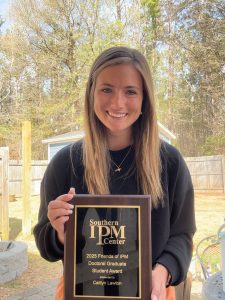
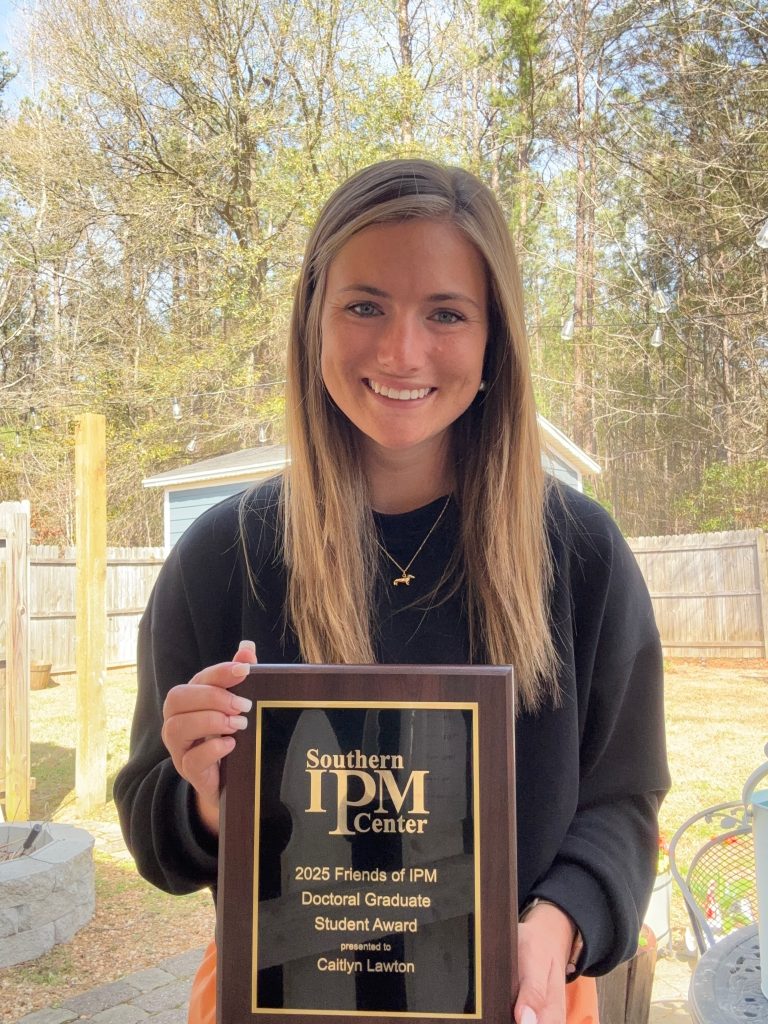
Caitlyn Lawton
Caitlyn Lawton, Auburn University, Department of Entomology and Plant Pathology
Dissertation: Integrated Pest Management Strategies in Alabama Row Crops
Areas of Specialization: Field crop entomology, with a focus on cotton IPM
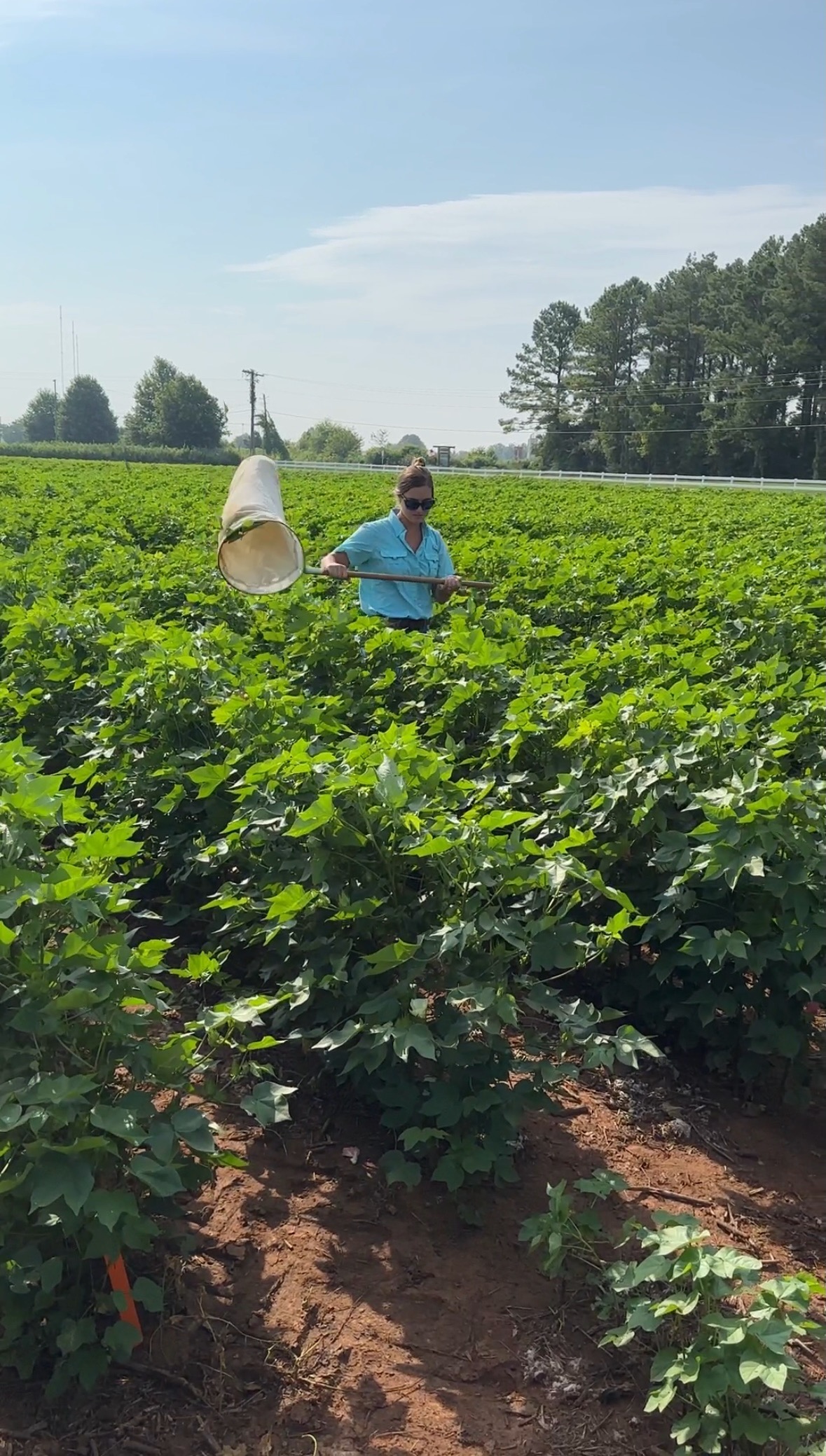
Caitlyn Lawton is a second-year Ph.D. student at Auburn University, where her dissertation research focuses on integrated pest management in cotton, corn, and peanuts. Caitlyn also works with Alabama Extension in corn, small grain, and forage entomology.
Research
Caitlyn’s innovative research focuses on multi-crop IPM strategies. Specifically, she works with ThryvOn cotton, a genetically modified cotton variety that offers built-in protection against thrips and tarnished plant bug (tpb). Caitlyn’s research carefully assessed how nematode species impact ThryvOn cotton. She found that while ThryvOn effectively controls thrips, nematodes negatively affect the variety’s health and yield.
Caityln’s research illustrates that farmers should emphasize nematode management in highly infested cotton fields. To reduce pest management costs, farmers should pair non-ThryvOn varieties with premium nematicides, except in areas with high tarnished plant bug pressure.
In addition, Caitlyn has conducted research to evaluate insecticide use strategies in high-pressure tarnished plant bug situations. Her findings suggest that if timely insecticide applications are made, farmers can expect to use reduced rates of recommended insecticides to preserve cotton yield.
Caitlyn’s extraordinary ability to address pest management with sound, science-based strategies reflects her strong analytical skills and commitment to IPM principles.
Publications
Caitlyn has continually impressed her colleagues with her enthusiasm for communicating her research findings and pest management recommendations to farmers and stakeholders.
To promote awareness of IPM strategies in agricultural settings, Caitlyn has published several practical extension articles about corn insect management on the Alabama Cooperative Extension’s website. She was also interviewed for a fascinating article about the impacts of fall armyworm outbreaks in Alabama. Through her extension work, Caitlyn contributed to four editions of the Alabama Crops Report newsletter, which distributes timely information about crop conditions, pest pressures, and current irrigation and fertility updates.
Caitlyn even recorded a pest patrol hotline on fall armyworm management in pastures and soybeans to provide growers with up-to-date information about emerging pest threats in their area.
Presentations to Stakeholders
Since Alabama Extension does not currently have a corn, small grains, and forage entomology specialist, Caitlyn willingly stepped in to perform some extension responsibilities, including delivering presentations to stakeholders and authoring extension publications.
In 2024, Caitlyn confidently delivered five presentations at county production meetings and addressed the status of IPM in cotton, corn, and peanut crops. Caitlyn has also given six talks at Auburn field days, where she interacted with extension specialists and provided updates about current integrated pest management practices.
Caitlyn has led in-service training for Alabama Extension Regional Agents. At the extension trainings, she taught extension agents how to properly use new ‘smart traps,’ a pest surveillance system developed by FMC, to monitor corn earworm and soybean looper moth flights across Alabama. A smart trap is a camera-equipped trap that records images of trapped insects and uploads them to FMC’s Arc Farm Intelligence App. The clever monitoring tool allows growers to remotely track pest populations and make informed crop protection decisions.
By overseeing 121 traps across all growing regions of Alabama, Caitlyn helped provide extension agents with real-time data on moth flights in their area. Alabama extension agents dispensed the vital data to growers, enabling them to effectively determine when to intensify monitoring for corn earworm and soybean looper in the field.
Additionally, Caitlyn trained extension agents on how to correctly employ pheromone traps for the soybean looper moth and bollworm moth, pests of cotton.
Caitlyn has presented at Cotton Scouting Schools and delivered updates on secondary pests of cotton to provide insights into plant bug management in the new ThryvOn cotton technology. Caitlyn successfully trained 146 Alabama Cotton Scouts in 2024. Caitlyn promoted the adoption of IPM in cotton as she taught cotton scouts about pest identification techniques, thresholds, and management considerations.
Special Thanks and Future Plans
Caitlyn would like to thank her boss, Dr. Scott Graham, and Dr. David Held, Auburn’s Entomology and Plant Pathology Chair, for equipping her with unique opportunities and experiences during her time at Auburn. She would also like to thank the Southern IPM Center for generously bestowing this award.
Caitlyn is tremendously thankful for the extensive support and encouragement she has received:
“I am beyond grateful for everyone who has helped and pushed me along the way, including my fiancé, family, and other student workers/graduate students.”
After graduating from Auburn in December 2025, Caitlyn intends to continue her work in agriculture. She hopes to find a position in extension or industry that will enable her to collaborate with growers and consultants from all over the United States.
2025 Friends of IPM Awardees
- Bright Idea Award: Dr. Nupur Sarkar, Dr. Lina Bernaola, and the Bernaola Lab, Texas A&M University
- Pulling Together Award: MyIPM for Vegetables team, led by Drs. Rebecca A. Melanson, Tom Kuhar, Tom Bilbo, and Inga Meadows
- IPM Educator Award: Dr. Sonja Swiger, Texas A&M University
- Future Leader Award: Dr. Scott Graham, Auburn University
- IPM Hall of Fame Award: Eddie McGriff, Alabama Cooperative Extension System
- Doctoral Student Award (2 winners):
- Rogan Tokach, Auburn University
- Caitlyn Lawton, Auburn University
Other 2025 Recipient Stories
MyIPM For Vegetables Team
MyIPM for Vegetables supplies producers with IPM information for disease...
Read MoreDr. Nupur Sarkar, Dr. Lina Bernaola, and the Bernaola Lab
Implementing Plant Varietal Resistance for Management of the Invasive Rice...
Read MoreSonja Swiger

Sonja has provided valuable training courses on vector identification, disease...
Read More